
❝AT TWELVE DEGREES NORTH LATITUDE, on the eve of the main celebration, Lije and I walked down to the historic center of the village (officially a monastic city with the extraordinary qualification of a World Heritage Site since 1978 and nearly twenty thousand inhabitants). The flow of people and livestock was endless, but there were few foreigners lost there on such a significant date, mostly Italians.
On the way to or from our hotels 'ferenji' (in Amharic the plural of ferengi is 'ferenjoch') we played some jokes on each other, like guessing our nationality. Lije asked me, amazed, if I could tell someone's nationality by their appearance or clothes. I told him no, that unless I overheard them talking, it was just guesswork, though sometimes I was right. I could spot Italians, who speak as loudly as we Spaniards do, by their voices, and by the time we crossed paths, I had a head start. A few kind words would pique their curiosity, and they'd ask questions. I admit, they found me out a few times.
Within this game, that same afternoon I found myself, going to Bete Medhane Alem, the largest church in the group through which one accesses the rock art complex, to Cristina García Rodero: a monster of visual anthropology, she went back to rest. I didn't recognize her at that moment. I only ventured a guess with my guide, who was Spanish. My first words in English were to ask if, by chance, as I suspected, she was Spanish. Her guide in Spanish—she spoke both Spanish and English equally fluently—answered that yes, she was Spanish. So I went straight for it. Peeking out from her small backpack a copy of the unique black and white book about Lalibela, Close to heaven, I immediately notice and tell her that there couldn't be a more devastating post. Devastating? she replies, staring at me intently as if waiting for an urgent explanation.
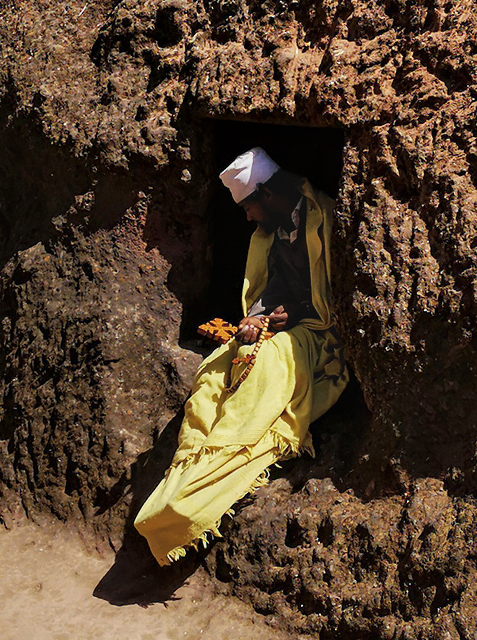
Scenes like this one of hermits in the hollows of the base of the rock art complex have practically disappeared today.
I mean, as I answer on the spot, that this Lalibela is personal and non-transferable; no one will be able to photograph it or find it exactly as it appears in Rodero's book if they come here, I try to explain. That's why I say it's devastating, because it forces you to search and compare your results, followed by frustration, even if you're not a photographer. Yes, by García Rodero, she adds, and says to me: That's me!
We have to get together for lunch! we agreed. Cristina revealed herself to be a real foodie. The next day, which was Christmas Day in these parts of Orthodox Christianity, we met up with our guides to celebrate at the restaurant of Sora Lodge, a charming dining room at the far west end of Lalibela where its glass-enclosed panoramic view over the valley tries to distract us, without success or time, I must point out.
Since she had decided to stay in Lalibela while the Spanish group she had come to Ethiopia with visited other places and her guide, who was the group's guide, would continue with them, she joined my plans to see the rock churches in the surrounding area without me having given her any details, which we both already knew.
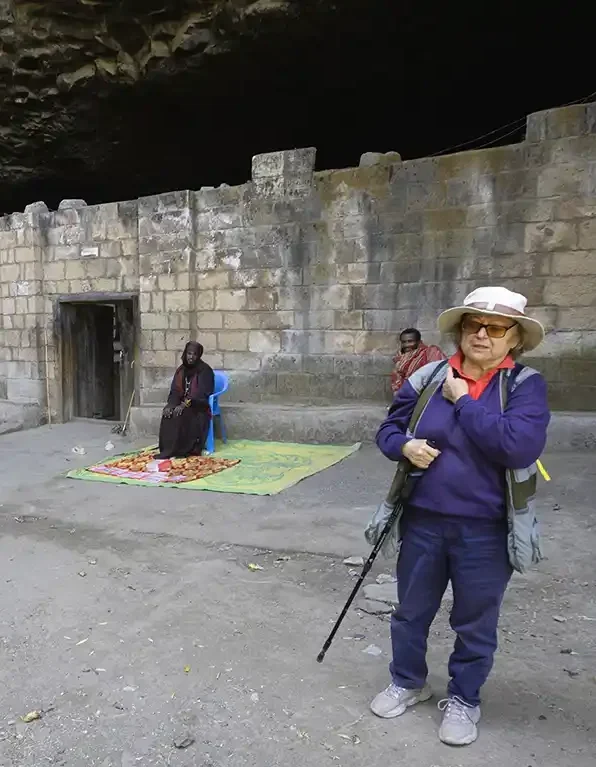
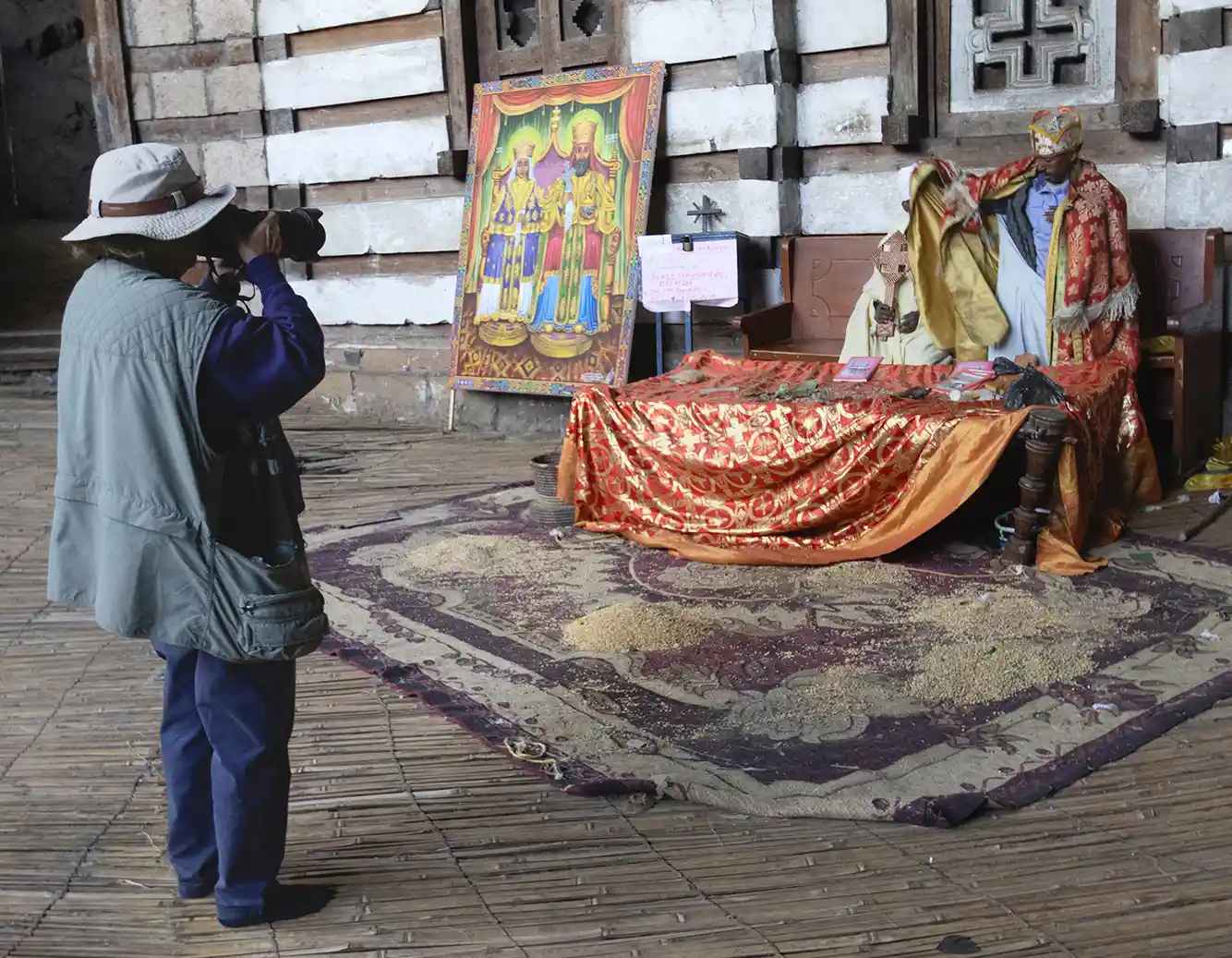
Ready to enter the prototype church, Ymrehana Krestos, after a short pause at the entrance to the compound.
Cristina was staying at the Bete Serkie Hotel. They prepared a continental breakfast for her with coffee and pastries. They didn't know she was a world-renowned photographer, nor the newly minted Marchioness of Valle de la Alcudia, but they took excellent care of her, in a word. They would pick her up from her hotel, and from there the daily expedition would depart. On the way back, a light snack of the cold cuts she herself had packed in her suitcase for those brief moments at the tables in the entrance. Then, dinners at the Blue Nile, by bajaj, or the The Tabor crossing through a private passage opened at the back of the Bete Serkie and reaching the other hotel in two minutes with flashlights.
When we arrived at our destination, Cristina simply disappeared. She only skipped the Asheton Maryam Monastery because from the point where the SUV dropped you off to the summit was a steep, narrow gorge inhabited by goats. He missed a long scene of a possessed woman, but was able to partially compensate by going to Naakuto Laab the last day. She was chasing the image of a pilgrimage she remembered from her first visit. After two hours at the site, the driver and the guides were urging me to return, but Cristina remained immersed among the pilgrims.
Except for the first day, with Lije, we left the rest in the hands of my new guides Tasfiye and Ermiyas.
In the vicinity of the hotel, I met Ermiyas and Tesfaye the day after my arrival in Lalibela, as I wrote in another journal entry. Ermiyas was more talkative, mainly because he spoke English better than his companion. Although they didn't hint at or mention whether I had a guide, I told them that my guide would arrive a day later and that he had already been here twice before and to Ethiopia three times. I even mentioned that I had friends who lived near them, although they all currently lived in Great Britain.
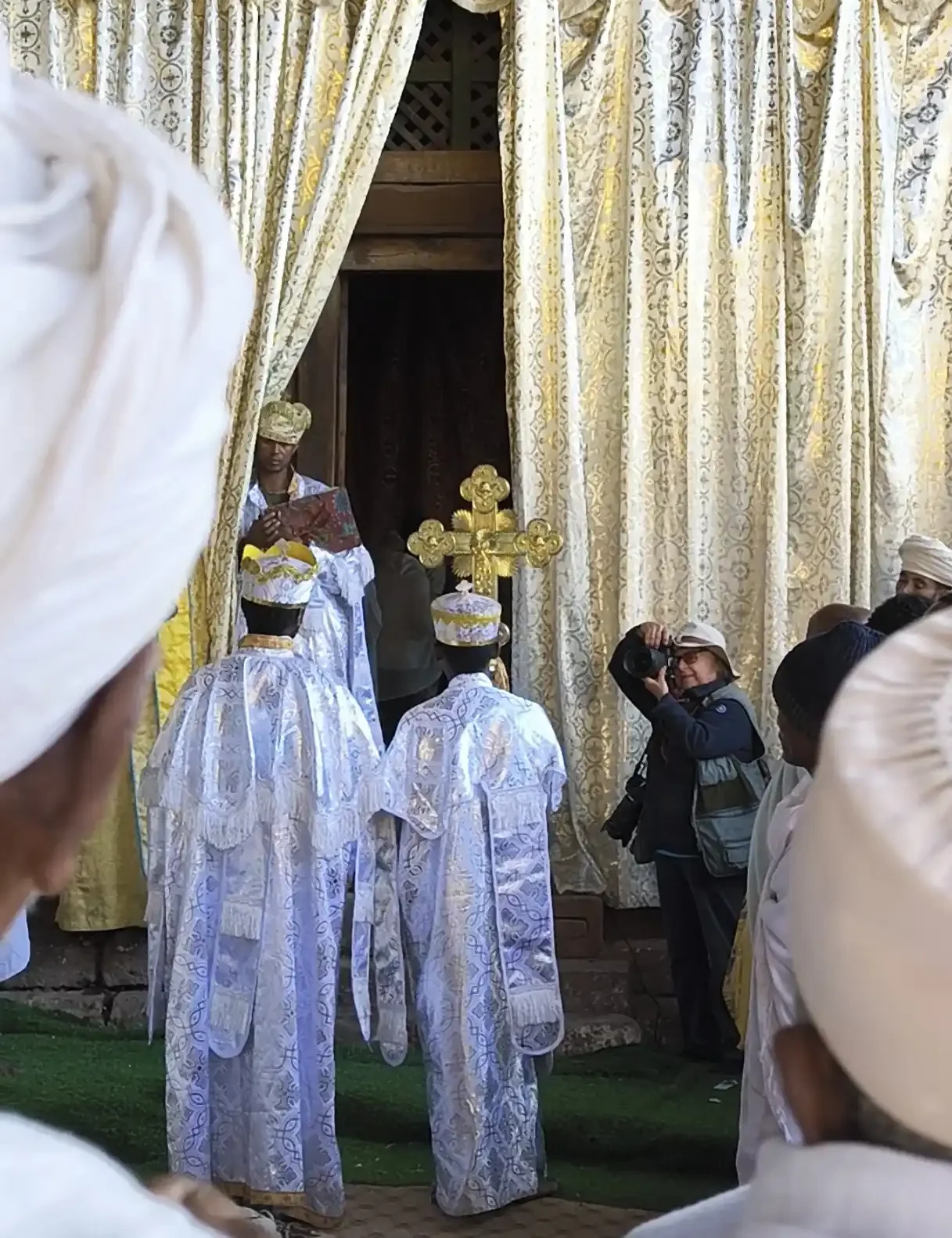
They were astonished because one of them, Lidetu (Luda for short, but also Christian or Xris, who patiently taught me all the basic vocabulary and pronunciations I know), was not only known to them, but they ended up taking me to his house and introducing me to his mother. We were just a stone's throw from my hotel and four from his house, and there we were, showing up unexpectedly. Luda's mother was going to prepare a special family meal to celebrate her son's birthday, even though he was away. It just so happened that it was the next day, January 4th.
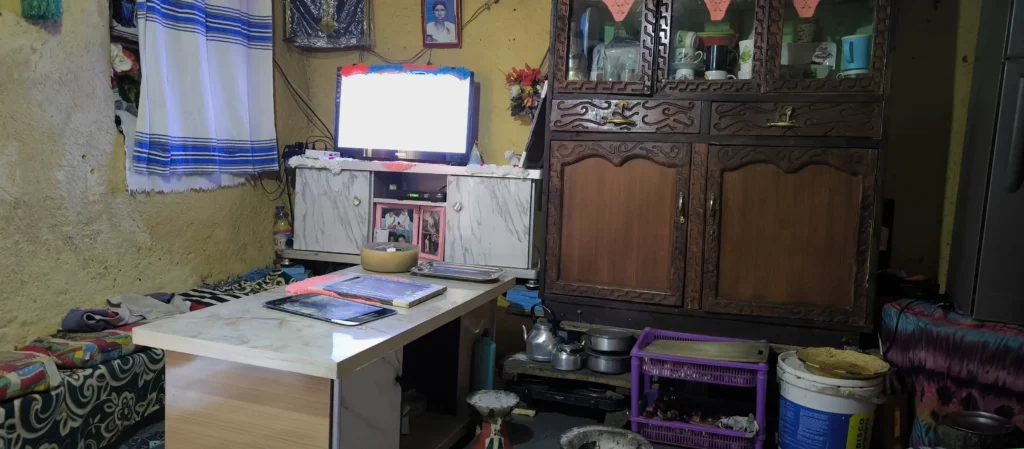
Luda's family's living room looked this great on the eve of her birthday celebration when I showed up unannounced with Ermiyas and Tesfaye and her mother and brother welcomed us with infinite hospitality.
As soon as we crossed the landscaped courtyard that separates it from the bustle of the street in front and left the house, I hurried to ask what I could bring as a gift. Without hesitation, they agreed that the best option was green coffee beansWith a nice piece of paper that they gave me at the Blue Nile And I arranged the package with some flowers from my hotel. Luda was equally amazed. I wished him a happy birthday privately on social media (he was surprised I knew the date), but I also added that he would be celebrating with his family at his house.
SS, Luda's mother, had not only been cooking for the occasion, she had not only toasted and prepared at length Ethiopian-style coffee (amidst puffs of incense with his 'jebena buna': (a complete ceremony), the living room was carpeted in yellow with branches specially cut from her garden, and framed photographs of her son were placed on it. With equal parts hyperactivity and elegance, she arranged everything and, without losing enthusiasm, acted as hostess, with three additional guests.
Before I left, we had a couple more encounters, and when I said goodbye, which I did without Ermiyas and Tesfaye, no words or interpreters were needed. She embraced me again with the same immense arms as those Virgin Marys in Ethiopian paintings that seem to leap out of the frame to protect you ●